Wednesday, December 25, 2013

Take a Hike...If you dare.

After 22 hours, I'd had enough.

The ice-mist had been steadily falling since 5:00 PM the previous evening, just before my extended family packed themselves into my aunt's SUV to head home from our Saturday early-Christmas dinner. I don't think I set foot outside the house all day, and I was seized with the sudden need to stretch my legs before night fell again. I decided to leave the rest of my gift-wrapping for later, laced up my almost comically thick hiking boots, donned a winter coat I hadn't worn since high school, and headed out into the sub-freezing afternoon air. 

As I half-walked, half-slid down the icy road that connected my childhood home to the growing commercial hub a mile or so away, I became more and more aware of how much I'd come to take the walkability of DC for granted. The snowbanks, ice and slush that lined the streets were honestly the least of my problems- the sheer lack of pedestrian infrastructure shocked me much more than I thought it would. I mean, I'd traveled the road hundreds of times before, and knew full well that it was basically impossible to get around much of my suburban home city without a car. But when I passed the desolate looking mall...

How many shopping days left?


...and continued toward the roundabout that, on most days, would be controlling the traffic flow through the area...

I think there was a sidewalk here at some point? Maybe? I can't be sure.

...I suddenly realized that I was that guy. The guy that I, myself, had vocally or silently made fun of dozens of times while still living at home. As some hapless walker would hop between curbs, and negotiate the travel lanes like some high-res version of Frogger, I'd voice a mix of sympathy and disdain for this poor soul who either didn't have access to a car, or had somehow CHOSEN not to use one. In the same way that 17 year-old me couldn't imagine wanting to travel any other way than by car, 29 year-old me was taken aback not to be given the option. Not really, anyway- I have to assume that the motorists who slowed to let me cross the street did so only out of the same misguided blend of sympathy and disdain I used to feel, sprinkled with a little Christmas spirit perhaps.

Of course, I made a conscious decision to get to the Mount Auburn Ave. Starbucks the way that I did. Many people, both here in my first home and in my adopted home of D.C., don't get to make a choice about the way they get around every day. And while downtown, Eastern Market, Columbia Heights, and other places I've lived are easily walkable and bikeable, so many parts of town are structured more like my suburban hometown. People without a car or who'd rather not use one are confronted every day with the obstacles I sought out while on vacation. I imagine the thrill of adventure would get old pretty quickly.

I couldn't even imagine what it would take to make this area, and other like it, more pedestrian and bike-friendly. The one half-assed bike lane on one side of the street ran for a whole 100 feet and ended promptly at the curb where the road narrowed after the turn-off. The sidewalks looked like they'd be an afterthought on the best of days.

 But I had to wonder if the area, and the dying mall in particular, might be better off with a few smaller stores and some useful infrastructure for pedestrians and cyclists- even to get from one side of the giant retail complex to the other without having to drive in between. Certainly, such a suggestion would be looked upon as wasteful, beneficial only to the few people who live nearby or are somehow both rich enough AND poor enough to be riding bikes around.

If you followed that link, by now you'll know a thing or two about what cycling does for the places that welcome it. So maybe a little bit of investment in non-internal-combustion-engine movement would do the area some good. At the very least, it might lessen the chance of an idiot like me getting hit by a car while sprinting from curb to curb across 4 lanes of traffic just to get a peppermint mocha.  And I think that's a goal we can ALL get behind. So as we close out December and get ready for 2014, let's put our support behind walkable and bikeable communities no matter where we are.

Merry Christmas and happy holidays, keep your 2014 resolutions reasonable, and for God's sake don't fall on the ice. Or off the curb.

-AWG

...one that all the children call their favorite time of year.

Tuesday, December 17, 2013

Collaboration and its Discontents

Like most of you who use Skype even occasionally, I sometimes get e-mails about the stuff that they're doing or want me to participate in. Also like most of you, I get way too many e-mails in general. The majority of the stuff Skype sends me doesn't even bother to look interesting, so their messages tend to be summarily DELETED along with all the "special offers" from every store that's ever sold me something online. Yes, I realize I can unsubscribe from like every single one of those. But this is me we're talking about. What if I happen to be in the market for a mechanical omelette flipper and I don't know I can get 90% off at Bed, Bath, and Beyond because I didn't get their stupid e-mails? What then, check the website? WAY too much work. Yeah, welcome to my brain. It gets dark in here sometimes.

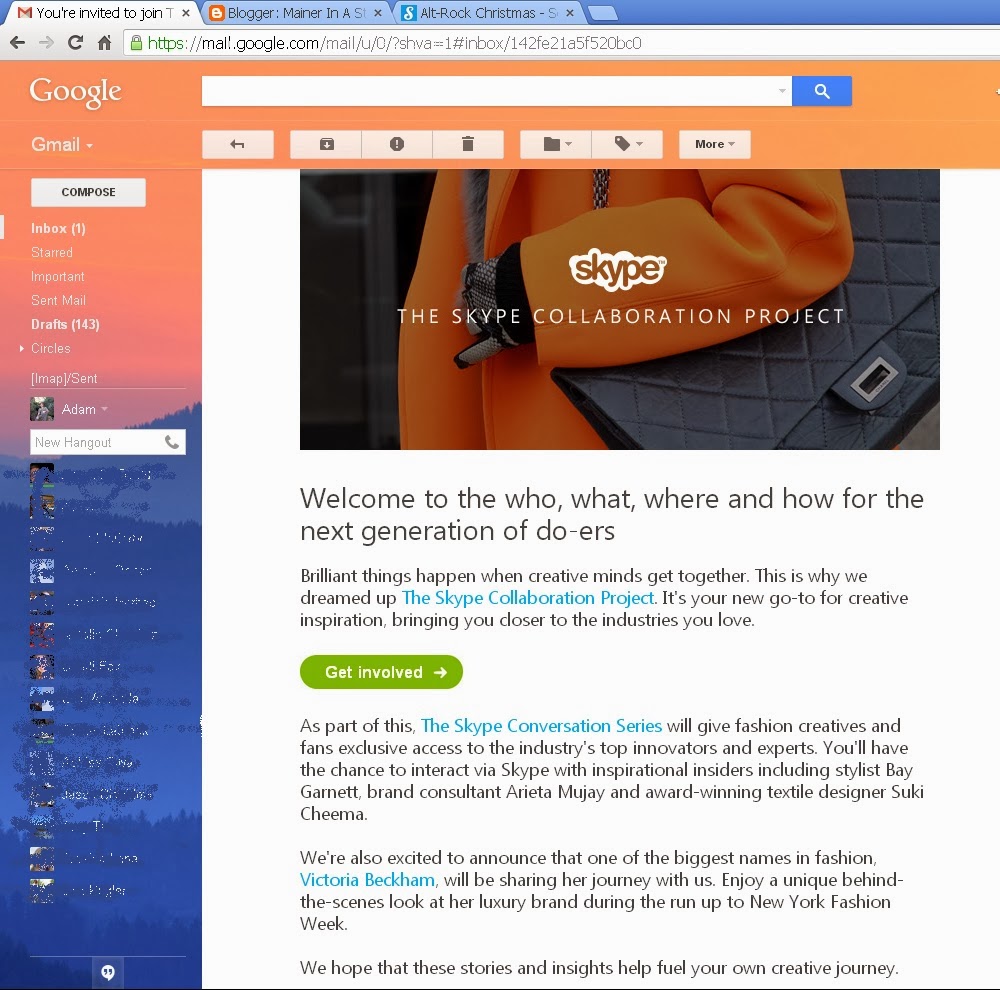
Anyway, I was conducting my daily mass deletion of junk e-mails last night when I noticed one from Skype that somehow caught my attention. The subject heading read: You're invited to join the Skype Collaboration Project.

"The Skype Collaboration Project? And I'm invited?!" I shrieked with excitement, thinking that my chance had finally arrived to do something meaningful. Having been inundated with studies and anecdotes arguing for the power of technology to foster understanding and forestall violence, and remembering the role played by social media during the Arab Spring, my thoughts immediately turned to the applications of Skype as a tool for peace. As I opened the e-mail, my brain was on fire with possibility- would we be conducting video panels on open government? Sharing insights on rule of law with local stakeholders? Participating in a dialogue for human rights advocacy? Harnessing the virtually unlimited power of technology for the betterment of a troubled world?

No.

None of the above. Promising "the who, what, where, and how for the next generation of do-ers, " Skype had instead blessed me with the opportunity to cuddle up to my "favorite industries" and have them tell me what I ought to putting on my lanky frame over the next 20 years. As an added bonus, I'd get to hear Posh Spice wax nostalgic about her own meteoric rise as a...whatever she considers herself to be. I guess some lesser gods of fashion and design would also listen to my puny contributions? Maybe? At some point?

"When in doubt, pinky out"


The whole thing is nominally aimed at helping me "fuel [my] own creative journey," but let's be honest here. To the extent that I even have a creative journey, stylists, brand consultants, and award-winning textile designers probably aren't going to be prominent characters in it. Are these really the "do-ers" I should be emulating?

Despite the lofty rhetoric, somehow this seems like the darker side of "collaboration," like locals collaborating with an invading military force or something.

I mean, I'd almost rather they just gave it to me straight and said "We know you like to consume, we've been tracking your page visits. Why don't you go ahead and cozy up, and we'll tell you what to buy and what to talk about. You'll even feel like you're making a difference, a little!" I think I can indulge my inner Little Eichmann just fine on my own, thank you.

Then again, maybe I'm looking at this the wrong way. Maybe some of my "favorite industries" could include breweries that support sustainable transportation initiatives. I literally just thought of this. Textile makers/designers committed to socially just sourcing and labor standards. IT companies dedicated to connecting under-served and marginalized populations and fostering civic engagement. Corporate social responsibility! Maybe this could be a tool for good rather than just another attempt to splice rabid consumerism into my very DNA, and we should all get involved instead of being a Grinch about the whole exercise.

So all right, Skype. Let's see what you've got behind that "Get Involved" button. Let's see what the fashion world can do for the rest of the world if I decide to "collaborate." Cause I'll do it.

Right after I finish buying clothes and accessories and all manner of branded items for the people in my life this holiday season, to show them that I care.

-AWG

...but if you close your eyes, does it almost feel like nothing's changed at all?


Tuesday, December 3, 2013

Monday, Monday

I'm no different from everyone else- Mondays are not my strong suit. The day after a holiday weekend is even worse, since in my line of work, families getting together usually means lots of disputes to sort out the next time we open our doors. Even if you have a wonderful Thanksgiving weekend (which I did- Amanda time, chill time, dog time, lots of food, bike riding, and the Hunger Games,) the hangover of a new week hits you pretty hard. But letting myself feel drained and irritated by lunch time is not the most adaptive way to handle this inevitability, there must be a better way. Darryl at Loving the Bike tends to treat every Monday as a mini-Thanksgiving of sorts, a time to post about the things he's thankful for and happy about. I guess it must work- dude seems to be happy a LOT.

I'm always hearing that I should "choose my attitude," so in that spirit, I made a point of noting the best things I saw during the day yesterday. Fair warning, my observations are tinged with plenty of sarcasm, because a sea-change in worldview in the space of one day just isn't going to happen for me. Be assured, I really am trying. So, rank-ordered list here we go.

Cool:
Going to a spin class instructed by a woman who looked like she probably hadn't touched a bike in years, but was a surprisingly good coach.

Awesome:
A guy wearing a t-shirt with that "Injustice anywhere..." quote attributed to "Martin Luther King, Jr., American Activist." Because it's important to avoid confusion with all the other Martin Luther King Jrs. who might have said that thing.

Awesomer:
A bike cop with one hand holding his coffee cup and the other on the handlebars, talking on a phone that was tucked between his cheek and the chinstrap of his helmet. He rode up onto the sidewalk, I suppose to regain his balance, and got the antenna of his walkie-talkie stuck in between two parking signs. It took him a full 30 seconds to get it unstuck.

Awesomest:
A guy standing in the locker room, eating Milano cookies in his underwear. Unclear whether he was about to start his workout, or had just finished. Which would be funnier?

So there we are. Good/funny things on a Monday! Positive attitude! Holiday Cheer.

Bonus:
Went to buy batteries, and almost said "B-batteries" in a fake stutter to the lady at the counter because of a Demetri Martin joke from like 6 years ago.

Happy Tuesday!

-AWG

...I think we could use a little memory to add to the database.

Wednesday, September 18, 2013

A thank you message...

I want you to know how grateful I am to you. You know who you are. Very, very grateful indeed.

I was going to just post this directly to Facebook, but come on, you know how verbose I am and it seemed crass somehow to put up such a long/gushy status message.

So here we are. Thanks to to you, my amazing friends, family, and coworkers, I have met (and exceeded!) my fundraising goal for the Best Buddies Challenge this October. And we did it a full month ahead of schedule. You guys (and girls) rule. The most. Seriously. I'm touched to be surrounded by such generous, supportive, good-hearted people.

As you well know, I feel strongly about the importance of Best Buddies' mission- to enhance and enrich the lives of people living with intellectual and developmental disabilities through services, advocacy, and person-to-person partnerships. I'm thankful for the opportunity to combine my love for cycling with such a worthy cause. And I'm doubly thankful that you were so willing to step up and help me meet the challenging fundraising commitment, several of you chipping in for the second year in a row.

A 100-mile bike ride is no easy jaunt, and while the Challenge isn't a race, I'm determined to do you proud out there on the route. My training continues into the fall, and I'll be testing myself against the mean streets of Berryville, Virginia along with a few of you this Sunday at the Back Roads Century. With all that and more riding through October, I should be in pretty good shape for 10/19.

So a thousand thank-yous to each and every person who chipped in to support me this year. I really could not have done it without your help.

--AWG


Friday, September 6, 2013

I can't back Obama on this.

OK, so we're possibly days away from going to war. Again.

I can't help but remember a page from one of my history textbooks in high school. It showed a map of Europe on "The Eve of World War II." I remember thinking that was kind of a comical way to put it, since I usually associated the word "eve" with Christmas. We all knew when Christmas eve was coming (and were excited for it!) but with war, how could you know until afterward that it was "the eve?" Well, as I later learned, sometimes the signs are pretty clear.

Sure, maybe we could still avoid it. Maybe the Senate won't give its approval to military action. If they do, maybe the House won't. It's been one part fascinating, two parts mind-numbing to watch an endless stream of journalists and pundits try and pick apart how the legislature is going to shake down on the question of going to war in Syria. That's not a dig against the pundits, they're only doing their jobs, of course. But there's been a bit too much made over the fact that anti-war progressives will suddenly find themselves in bed with conservative hardliners(!) who will do anything to derail President Obama, or that right-wing hawks will find common cause with left-wing humanitarian doves, lions will lie down with lambs, swords to ploughshares, etc. and so forth. Yes, the debate over military action has transcended the heavily partisan political dynamic that's dominated the last few election cycles, or at least flipped it upside down for the moment. Still, I think the bigger question, and the bigger story, is whether the people who elected all these characters will be in support of the decisions their representatives ultimately make. Will our (still hypothetical but increasingly likely) intervention in Syria have the backing of the American people?

It looks more and more as though it wouldn't/won't.

I'm not the first person to suggest this, certainly. Long-time war protester Medea Benjamin, writing for Al Jazeera, pretty clearly thinks the Obama/Kerry one-two punch is trying to hoodwink us on this one.  If so, where's our outrage, our vociferous opposition to having our collective will hijacked by the foreign policy old guard who see no alternative to humanitarian intervention by force? Well, several people from both my own social circles (such as they are) and the news media have used the phrase "war-weary" to describe American skepticism. While I imagine the people who inhabit the war zones are much more wearier than are we, it's a fair way to characterize the mainstream response I've seen so far. We're vaguely distrustful of our leadership's slow grind toward military action, but there seems to be a certain weariness to arguing against it as well. There's both a sense that Obama could still easily proceed with the "limited" strikes he's looking for with our without congressional or multilateral approval, and that our path comes down to a choice between the lesser of two evils.  

Guess what? I'm calling shenanigans on the "no good options" line of reasoning. First, we have options. Medea Benjamin has a couple- including addressing the refugee crisis that the Syrian civil war has created. Matt Yglesias at Slate suggests working with the United Nations. That will probably lead to stalemate between the Western and the Sino-Soviet votes, and maybe the U.N. still doesn't have the kind of teeth necessary to take on an assignment like punishing Assad for chemical weapon use. That's a common and somewhat valid criticism of the U.N., but if we keep refusing to work with them and going it alone, we'll never develop the kind of mature multilateral institution that can meet challenges like this. Even if we can't count on the U.N. for a police action, we can still activate its potential for creating networks of facilitators at different levels both within Syria and without, to begin a constructive dialogue and search for nonviolent solutions. That last one comes from Johan Galtung, the father of my discipline and one of the world's foremost minds in the prevention of violence.

Though some of these options are perhaps overly simplified, I can't understand why they're not being explored and fleshed out, or even exposed to a wider audience. No, support for refugees or working toward a mediated solution won't immediately stop the killing in Syria, but then again, neither will U.S. intervention, whether it's cruise missiles or boots on the ground. In fact, there's evidence to suggest that intervention would actually multiply the violence against civilians, since government forces become more desperate when an armed rebellion receives support from a foreign power. More Syrians will die before a solution is reached, and that's truly heartbreaking and tragic, but as soon as we step in with our own armed forces, the pace will only pick up.

So if we're not likely to end the violence by doing more violence, and strikes against the government will lead to even more widespread suffering, why not at least search for a path which doesn't damage our legitimacy as an international actor? Why not be the sort of world leaders we describe ourselves as in inaugural addresses and stump speeches, and help usher in the advent of collaborative, non-violent solutions to violent conflicts?

Because al-Qaeda, obviously. Because Iran. Because if we don't back up Obama's "red line" comments about chemical weapon use (for whatever that's worth,) we'll be seen as weak. Ayatollah Khamenei and President Rouhani will doubt our commitment to projecting power into the Middle East. And if the wrong (read: Islamist) rebels win, al-Qaeda will gain a foothold in a country currently ruled by a fiercely secular government. Perhaps that might not be great for U.S. interests.

And that's why, on Syria, non-US government actors are ultimately going to be much more productive in stopping the violence, punishing the state's atrocities, and finding a sustainable political solution to the crisis. It's time to create some space for that to happen. So, guys, maybe don't fire any missiles just yet, huh? Instead, let's work on creating space for dialogue, mediation, and legitimate action. Who's with me?

--AWG


We cannot solve our problems with the same thinking we used when we created them- Albert Einstein

Friday, August 23, 2013

In Case Anyone's Forgotten that the Amazon is in Peril

It's been a year to the day since I left Ecuador. I came back to the States in awe of everything I had seen, learned, and experienced while living in Quito. Above all, I was greatly impressed by the general sense that innovative solutions to massive challenges were still within reach. One of those solutions was the Yasuní-ITT Initiative, a plan to keep a large amount of Ecuador's oil underground forever, and thus protect the delicate ecosystem sitting on top of it.

And last weekend, I got the devastating news that it had failed.

Yasuní National Park... drill, baby, drill.
Image credit: EarthFirst News. 

The Yasuní initiative was nothing if not ambitious, I had heard last summer from former minister of energy Alberto Acosta, who spearheaded the program. The situation was essentially this: advancing economically through oil exports has been the default move of oil-rich countries like Ecuador since approximately forever. But oil extraction has a high price, including environmental degradation and loss of biodiversity, the often forcible displacement of anyone living nearby, and the danger of local economies being made dependent on oil jobs that will dry up when the crude does. Alternatively, the country could invest in biotechnology and research into the medicinal potential of its vast Amazonian biodiversity. That path, while leading to a much more sustainable future, takes time and money. How, then, to support the economy in the meantime?

Enter a novel concept called "co-responsibility," the global community's shared obligation to fight climate change. Developed countries, having already gotten rich from their vast and environmentally toxic industrial revolutions, have no right to expect a developing country like Ecuador not to exploit its own mineral and hydrocarbon wealth. "Make it worth our while," is essentially what Ecuador and the United Nations Development Program had said to the world. "Pay us half of the money we'd make from that oil, giving us capital to invest for the future, and we'll keep it underground indefinitely." The money would only be withdrawn from the UNDP trust if the program was ultimately a success.

Of course Yasuní was a long shot. It was a completely new way of looking at things. And sure, there were probably some governments who viewed the plan as an extortionist ultimatum- "give us money or we drill," but it was still a massive break from the old development model- one which could truly benefit the whole world. That was exactly what made it so fascinating, and its failure so heartbreaking. The plan was beautiful and simple, clearly too beautiful and simple for this world.

The immediate consequences may not be all that deeply felt. President Rafael Correa has given his assurance, for whatever it's worth, that only about 1% of the protected territory will be affected. That number strikes me as just a little far-fetched, though. The Guardian, reporting on Yasuní, noted concern from researchers that infrastructure including access roads would vastly expand the impacted territory. And that's only if everything goes according to plan (which, of course, it rarely does.) Petroleum companies have a troubled history of operating in the Amazon-- a quick search for Chevron-Texaco in Ecuador will give you plenty of detail . Human suffering and environmental costs have been dire, which is all the more upsetting for a country whose constitution was the first to grant legal rights to nature. Maybe they'll do better this time, but the environmentalist community is left holding its breath for now.

"The world has failed us..." Correa places the blame squarely
on the shoulders of the international community.
Image credit: TrustMovies

Far more troubling than the short-term effects, however, are the long-term implications. Yasuní-ITT was the only major project that had envisioned a future beyond our and relentless exploitation of hydrocarbons. A serious proposal to avoid digging for oil was, frankly, groundbreaking. Overambitious or not, it sent the message that, hey, maybe we don't have to extract every natural resource just because it's there. But now it appears that even if we don't have to, we will.

I can almost hear Correa saying "But we did have to, I had no choice." And yes, the president noted that he has a responsibility to Ecuador's poor to make smart economic decisions. But again, those words ring a little hollow since there's no guarantee that the poor will share equitably in the gains made by exporting the oil.. To the contrary, it's often poor and rural citizens who suffer most from resource extraction. Regrettably, "poor" in the Andes still correlates pretty strongly with "indigenous," though poverty can mean different things across cultures. In any case, Correa has made his presidential career out of disparaging and sidelining his critics, especially environmentalists and the indigenous who oppose his development policies. There's no reason to think his behavior will be any different this time. Lacking political protection, indigenous communities living above oil deposits have a hard choice to make: become employees of the company, leave their land, or stay and fight.

Ecuador has a long and robust tradition of nonviolent civil resistance to oppressive or damaging government policies, and such protests have never led to large-scale violence or conflict. In fact, protests over Correa's move are already underway in Quito, and have remained peaceful for the time being. But what if the government presses ahead in the face of such criticism? Direct intervention is well within the realm of possibility. Communities affected by mining and drilling operations in the Ecuadorian Amazon have often attempted to physically block or dismantle mining camps and roads, and continue to do so in some corners of the country where mining operations are ongoing. Unlike the protests in the capital, though, such direct action will not necessarily be peaceful. Because oil companies and the government operate in such a close partnership, police or other state security forces are often called in to deal with the incidents, resulting at best in arrests, at worst in preventable violence. It's a disturbing vein in a worldwide trend toward the criminalization and forcible dispersal of nonviolent protesters, illustrated in great detail by recent events in Egypt.

"Ecuador does not love life," reads this protester's sign.
Image credit: Dolores Ochoa/AP via the Guardian


If Correa refuses to reverse course and oil exploitation begins in earnest, we can still hope that all parties will show restraint and engage one another in dialogue with the shared goal of doing as little damage to the Amazon as possible. But, just like the Yasuní-ITT initative itself, that's a bit of a long shot. For now, it's as if we've seen through a doorway to a different version of the future, only to have it unceremoniously slammed shut.

 
-AWG

...they say we're too yellow-bellied, we say we're the new superpower...

Friday, June 7, 2013

Frager's Hardware: 1920-???

In the capstone research practicum for my master's program, we talked a lot about institution building- the creation of processes, political spaces, and common understandings that facilitate democracy- establishing "rules of the game" and giving people a conduit through which to communicate their needs and interests without violence. Societies in transition, we argued, could not thrive without institutions.

Well, the other night, I watched a DC institution burn to the ground.

My roommate and I were having a beer on the back patio when the sirens started. Neither of us thought much of it, but as they blared on longer and longer and seemed to stay unusually close by, we began to get curious. Moments later, roomie handed me his phone, and exclaimed "Frager's is on fire!"

Indeed, the tweeted picture on the screen showed Frager's hardware store with smoke pouring from its rooftop. The sheer number of sirens in the area made it clear that this wasn't some burnt bagel or a spark in a trash can. Frager's was burning down.

As a reasonably intelligent human being, my first instinct was obviously to try and get as close to the blaze as possible. Whatever, I needed to get to the grocery store anyway and at roughly four blocks from my apartment, the disaster zone was basically on my way.

Even though I was already close by, being on the bike made getting there easier than it probably should have been. The police sentries outside the Capitol seem to be the only law enforcement officers in DC who have figured out how to keep cyclists out of places they don't want them. Everyone else either doesn't notice us, can't effectively block us off, or doesn't consider us a threat, any of which I'm fine with. I swung wide around a halfhearted emergency cordon, zipped down an alleyway, dodged a couple of fire trucks, and joined a crowd of my Hill neighbors outside a CVS. I had wondered if the worst would be over by the time I got there, since I always manage to be a latecomer to this kind of thing. I was almost hoping it would be over, and that everything would fine.

Nope.
Can't see the building? Yeah, neither could we. 
To give you an idea of the enormity of the situation, I should explain. Frager's, a three-building operation with  distinct hardware, paint, and equipment rental stores, has been a piece of living Capitol Hill history, serving the community for the better part of a century. During that time, they've stayed family-owned and operated, with as friendly and knowledgeable a staff as you're likely to find anywhere. In an era when most retail employees aren't paid enough to care about customers' needs or their store's image, Frager's hired local summer help, remembered the names of their visitors (and their visitors' dogs,) and could help you navigate a truly dizzying array of products to find exactly what you needed. When I wanted to reinforce a door frame in my first apartment in a misguided attempt to install a pull-up bar, Frager's cut down a 2x4 and helped me select mounting screws. When countless rides up and down Massachusetts Avenue inevitably shook loose some nut, bolt, or washer from my bike, a Frager's employee would disappear into a room full of tiny plastic boxes, and come back with exactly the piece(s) I needed. As one guy I don't know on Twitter put it, "Everyone on Capitol Hill has something in their home from Frager's." It's nothing short of an icon, a symbol of shared identity. So I can say with certainty that all of us in the crowd were hoping for the place to be saved.

As the moments wore on, though, it only seemed to get worse. At one point, flames started jumping up from the roof:


When the wind would shift, you could catch a glimpse of one of the ladder crews through the smoke:
I have no idea how I made this into a .gif.
At one point, I spied Ward 6 council member (Capitol Hill's representative on the DC legislature) Tommy Wells as he walked behind a fire truck near the building with a gas mask in hand:
I'm no photographer, but it IS him.


And proceeded calmly up the sidewalk to confer with other leaders and news media probably only 50 feet from the fire.
Middle ground, white shirt. 
Soon enough, it became clear that the fire department, despite their valiant efforts, were fighting a losing battle, and that all they could really do was try to keep the damage from spreading to the rest of the block. By that time, I had been standing with my fellow gawkers for close to an hour, in awe at the loss of everyone's favorite hardware, lumber, paint, lighting, kitchen, automotive, and cotton candy maker rental shop. It felt odd to stand in a crowd of people, watching each other as we watched it all go down. As we watched something we had all come to know and love die a fiery death. I saw no tears, crocodile or otherwise. Children played and people casually joked about unrelated things. Still, the sense of  sadness lingering over the assembled mass seemed to press down harder and harder the closer the sun sank toward the horizon.

Having absorbed enough collective shock and anguish for one evening, I resolved to take the metaphorical lemons and make some literal lemonade.

After hopping back onto Winona the Kona and going to Harris Teeter for a citrus juicer that I really would rather have bought at Frager's (sigh,) I met a Long Time Resident who said he had been inside when the fire broke out. All the staff and customers got out safely, he said, but it took "a real long time" for the firefighters to get on the scene. Had I bought any salt on my errand, I would  have taken his words with some of it (BAM!) because time tends to stretch and bend in a situation like that, so it's tough to tell how long the fire trucks actually took to show up. I'm sure it seemed like an eternity, though.

Reportedly, it was about 10:00 PM before the last ember died, some three to four hours after the the fire began. CM Wells called the event "devastating," and cast the store as a "family member" that the entire community would stand behind and support. Institutions, after all, are about people and ideas, not buildings or physical spaces. And in one of the frequent displays of just why Capitol Hill is such an amazing place to live, two charities that have very effectively focused community support during past tragedies past have come together to take donations and plan fundraisers, calling themselves "Friends of Frager's."

I think we're all going to be amazed by the efforts mounted to save this institution in the coming weeks. Frager's is gone, but not what it represents. So farewell for now, Frager's, we'll be seeing you again soon.

I guess I'd better go hit that donation link.

-AWG

I don't know where you're going, but do you got room for one more troubled soul?